


Technological Breakthroughs And System Enablement Of High-Speed Optocouplers
Jun 18, 2026
Leave a message
The real-time demands of industrial automation and digital control systems continue to escalate, imposing increasingly stringent requirements on signal isolation technology. As a core device in the field of optoelectronic isolation, high-speed optocouplers-through innovative carrier transport mechanisms and material system breakthroughs-have established a secure barrier for high-speed signal transmission in power electronics, communication control, and precision equipment. Their fast response and noise immunity characteristics are reshaping the standards of signal fidelity in high-noise environments, providing a foundational guarantee for modern industrial systems.
Overcoming Control Failures Caused by Propagation Delay
Traditional optocouplers respond slowly. When a motor needs emergency braking or rapid acceleration, signal delays can lead to inaccurate actuation, causing lag in power device control signals and resulting in motor torque fluctuations or power supply feedback imbalance. High-speed optocouplers employ low-capacitance photodiodes and carrier acceleration structures to compress propagation delay to the nanosecond level-much like upgrading a country road to a highway, allowing control commands to reach power devices instantaneously, thereby preventing motor jitter or power supply loss of control.
Penetrating Electromagnetic Noise Interference
The electromagnetic interference generated by motors and frequency converters on the factory floor is like distracting chatter in a noisy room. Strong electromagnetic fields in the field environment can distort signal waveforms, leading to equipment misoperation. High-speed optocouplers incorporate a "triple protection shield": a metal housing that blocks external interference, differential technology that cancels common-mode noise, and an insulation layer that prevents high-voltage crosstalk. This design enables equipment to receive commands accurately even under severe interference, significantly reducing unexpected shutdowns.
Adapting to High-Density System Space Constraints
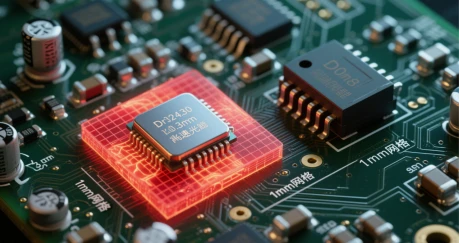
Modern equipment is becoming increasingly compact, and traditional packaged devices occupy too much circuit board area, constraining the miniaturization process. High-speed optocouplers adopt wafer-level packaging technology to achieve an ultra-thin form factor. This design significantly improves the power density of on-board charging modules while avoiding early failures caused by thermal stress, offering a reliable isolation solution for compact power electronics.
Resolving Multi-Protocol Interconnection Barriers
Differences in communication standards among industrial devices dramatically increase system integration complexity. High-speed optocouplers integrate configurable driver circuits that support protocol conversion such as CAN FD and Ethernet through pin switching, allowing simple configuration to accommodate mainstream industrial protocols. In IoT gateways, they enable lossless transparent transmission between Modbus RTU and TCP/IP protocols, simplifying the collaborative control architecture for multi-brand equipment.
Curbing System Risks Caused by Performance Degradation
Aging of optoelectronic materials can reduce signal transmission stability and increase maintenance costs. High-speed optocouplers, through ceramic substrates and CTR compensation technology, maintain stable photoelectric conversion efficiency across a wide temperature range. Applications in photovoltaic inverters have shown that this design keeps parameter drift within a very narrow range over a ten-year cycle, significantly reducing the frequency of power station operation and maintenance.
When high-speed optocouplers eliminate timing and distortion issues in signal transmission through optoelectronic isolation technology, industrial control systems gain a completely new foundation for enablement. Their breakthroughs in delay control, noise suppression, and space optimization are building highly reliable signal chains for smart manufacturing and the energy revolution. Facing the microsecond-level control demands and extreme-environment applications of future factories, next-generation devices will continue to drive industrial automation toward higher performance levels through wide-bandgap materials and three-dimensional integration.